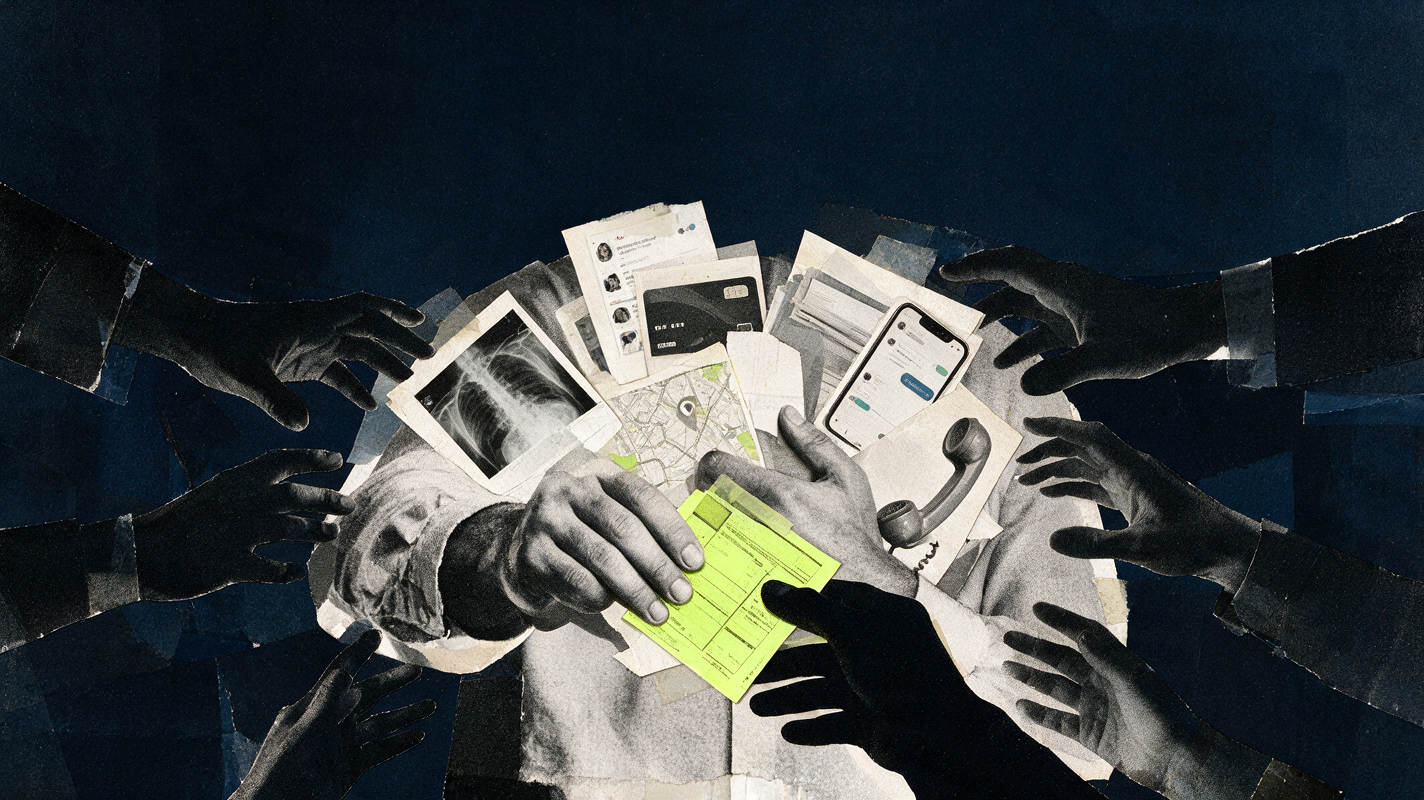
Your information is your property.
Whether cyberspace becomes a place of liberty and bustling commerce — or a place where our private lives are taken at every turn — comes down to the one institution that built the Western world: property rights. They ended feudalism. They can free us online, too.
ONLINE, THE LAW TREATS YOU LIKE A MEDIEVAL SERF
RIGHT NOW, TODAY
The moment your information hits the cloud, the law stops treating it as yours. Under a 1970s Supreme Court rule — the "third-party doctrine" — anything you hand to a service provider can go to the government on the government's terms. No warrant. No ownership. No recourse. That was the lot of a serf leaving their village in medieval times. Thieving highwaymen and feudal lords stripped them of their possessions. That’s why nobody traveled, and there was basically no trade and commerce.

At every turn, someone is taking your data.
-

Taxmen
Government agents use lax search-and-seizure rules to gather data about your private life — your location, your finances, your messages.
-
Highwaymen
Hackers take the same data. And when your information isn't legally "yours," it's not even clear that stolen data is legally stolen.
-

The Cloud Trap
Content on your phone is constitutionally protected. The moment it hits the cloud, weak and inconsistent statutory standards take over.
The Common Law Privacy & Consumer Protection Act
One simple ground rule: when a business places your unpublished personal information into a digital record, it's presumed to remain yours — unless the arrangement says otherwise.

What changes?
-

It stays your property
You keep property rights in your identifiable, unpublished personal information — even when it's stored or processed by a bank, a cloud provider, or a messaging platform.
-

A presumed bailment
When a company takes possession of your private information, the bill creates a presumption that it’s a bailment for mutual benefit — your info is held for you on the terms you agreed to.
-
Digital papers & effects
Now, just like records on your phone or in your home, records stored with an internet platform or in the cloud receive constitutional protection against unreasonable search and seizure.
-
Warrants required
Government entities can't seize or search your private digital records without a warrant based on probable cause — the same rules as for your home or phone.
What the Act DOES ✅
✅ Recognizes property rights in your information. You keep property rights in your identifiable, unpublished personal information even when another party stores or processes it.
✅ Creates a presumption of bailment.
When someone records your information digitally, a bailment for mutual benefit is presumed — subject to contractual terms.
✅ Protects digital records as your "papers" and "effects."
Whether stored locally or in the cloud, your private information receives constitutional protection.
✅ Requires a warrant.
Government entities can't access, search, or seize protected digital records without a warrant based on probable cause.
What the Act DOESN'T do ❌
❌ Doesn't stop you from sharing.
You can still voluntarily provide information to businesses, service providers, and other organizations.
❌ Doesn't stop companies from processing data.
Cloud storage, financial services, communications, and other services that need your data can continue.
❌ Doesn't block lawful government access.
Government may still access records with a warrant based on probable cause, or based on lower standards if you agree to them.
❌ Doesn't relieve you of responsibility.
You still must say no to services and platforms that deny responsibility for your information or that use your information in ways you don’t like.
It could all be fixed.
Property rights lifted people out of bondage and built the free, commercial world we know. It's time to extend that same foundation to the next frontier of human endeavor — the online world.
Support the Common Law Privacy & Consumer Protection Act, and help Americans traverse the online world as empowered, free people.